Category Archives: Theology & Culture

Give Nothing to Caesar

GOSPEL: Matthew 22:15-22
Then he said to them, “Give therefore to the emperor the things that are the emperor’s, and to God the things that are God’s.” 22When they heard this, they were amazed; and they left him and went away.

I don’t know about you, but this fall season has felt a bit like we living on the precipice of something big. As our quiet and homebound pandemic summer turns towards things we didn’t think we had to worry about. Schools starting, work places ramping up activity, dramatic elections to the south, and all of a sudden there realization that a change in seasonal weather will bring us closer to danger, the danger of being out and about with others, or spending too much time alone at home. All of it combines together to make us feel like whatever comes next will have important consequences. Maybe that moment arrived in Manitoba this week with soaring COVID cases… and maybe the big thing is still to come. 

Along the way, our journey through the Gospel of Matthew this fall has been in a smiler place. In the days between triumphal entry and the trial and crucifixion of Jesus. In the last few weeks Jesus has been telling parables to plotting Pharisees in the temple. The parable of the landowner who servants and son are killed when the go to collect the rent. And the parable of the mad king who sent soldiers after his wedding guests when they refused to come. 

All of it has been part of a plot to trap Jesus into saying something heretical.

And finally, we land today with the question taxes and authority. The Pharisees have questioned Jesus’ own Authority way back at the beginning of this series interchanges, and now they are questioning to what authority Jesus will submit. 

Now, before going any further, knowing some history is vital to understanding what is going on. The question of paying taxes to Rome, was more of a question of idolatry, than it was civic responsibility. Most people in Israel were taxed about 85% of their income. Some to Rome, some to the temple, some to pay off tax collectors, some to the Levites, some to the towns and villages in which they lived. People were bled dry for their money, and were often only allowed to keep just enough to survive. Most had to go into debt in order to make ends meet.

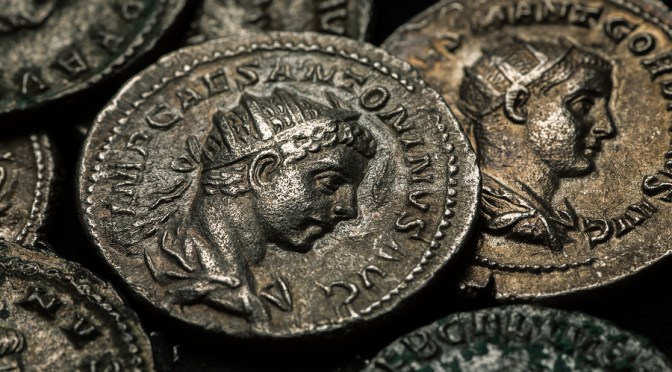
However, the issues with paying taxes to the Emperor had to do with the coins themselves. The Roman Denarius coin bore the image of the Caesar, with an inscription that read “Caesar Augustus Tiberius, Son of the Divine Augustus.” The coin was the symbol of Caesar’s godship.  

Yet, Israelites were prohibited from having any other God’s but the God of Abraham and Moses… therefore to even touch a coin would be sin. And yet, their Roman occupiers gave them no choice, since they all must pay taxes. This is why there were money changers in the temple, sinful Roman money needed to changed into pure temple money. 

The Pharisees were trying to trap Jesus so that they can get rid of him and his enthusiastic followers. 

They were attempting to get Jesus into trouble by making him either choose heresy by denying the one true God or to risk the wrath of the Roman Empire by undermining Caesar’s divinity.

Yet, in the way the Pharisees pose the question the reveal a problem of their own. They reveal their own use of God as an object. Their faith is revealed to be nothing more than a tool to be exploited, a means to obtain power and influence. Being a Pharisee meant status and material comfort. 

The Pharisees might not have even known or seen what they were doing. They had convinced themselves that their objectification of God was true faithfulness. The did not see how they were making everything about their own power and control. 

We don’t have Denariuses with graven images of divine Caesar’s in our pockets, but we certainly try to prop up and hold on to our power and control in the same way.  Christians aren’t above using God is a weapon to condemn and judge others, but more often than not, it is a matter of our trust and sense of security. Like the Pharisees we don’t even see the ways which we place our faith in ourselves, that we seek to control our world in order to protect ourselves from danger and fear. 

Especially during this moment of global crisis, especially when we are being called upon to trust authorities that call us to care for our neighbour and do our part, especially when delusion mad men are on twitter all day and in the news every night spewing lies and hate into air. 

Especially these days, our instincts push us to trust ourselves, and hold on to whatever power we can see, whatever security we can create, whatever delusion might give us comfort. 

It is a very human thing to try to make into God something we own and control and can use for our purposes. And it very human to rationalize acting out in self-interest because it is too hard and scary and exhausting to keep admitted how little control we actually have over the world. 

It is easier to believe the conspiracies about the pandemic, easier to convince ourselves it is nothing, easier to insist on life as normal in whatever ways we can. 

Only to discover that we have lost our way.  

And so when Jesus answer the Pharisees, he points to their contradiction. He asks for a coin… one that the Pharisees should NOT have inside the walls of the temple. (Jesus can be a little cheeky sometimes). 

“Whose head is on this coin?” He says. 

“The emperor’s” they answer. 

And then Jesus replies,

Give to Caesar what is Caesar and give to God what is God’s. 

*Mic drop*

So what belongs to God?

Everything. 

All creation. 

The entire universe.

And what then belongs to Caesar? 

Nothing. 

Jesus has caught the Pharisees in their own trap. 

But more thouroughly, he has made plain their own problems of faith. 

The Pharisees are using God as a tool, a weapon and a trap for Jesus, yet Jesus points them back to God. Reminding them everything belongs to God.

All things. All of creation. All of life. All power and might. All righteousness and virtue. 

And all Grace and forgiveness. All mercy. 

All faith. 

Even us and our broken faith belongs to God. 

But more importantly, giving to God what is God’s is NOT really ours to do. 

Because we cannot give anything to God. 

And that is thing that Jesus has caught the Pharisees with. As they try to trap him, and contain the threat of this ministry, and they try to protect the true faith of Israel, which just happens to give them a lot of power and privilege and wealth… Jesus reminds them their faith, that God is not a thing to control, nor tool to use to maintain their position. 

Rather, God is the one who to whom all things belong. 

And the Pharisees and all Jews knows this, even when they don’t remember it. Because they pray it at every sabbath, and they pray the reminder over and over at passover:

Blessed are you, O Lord our God, King of the Universe. 

And so giving to God what is God’s is truly to be reminded of the God to whom we belong,

is the God of Kings and Empires, of beggars and the lame, of regular folks. 

Giving to God what is God’s is to let go of our hope in ourselves, to let go of our efforts at control and security, to recognize that the power we think we have in this world is an illusion. 

Blessed are you, O Lord our God, King of the Universe. 

Jesus reminds the Pharisees and us that we cannot hold the power of God, no matter how hard we try. 

Rather that The Lord God, King of the Universe is holding on to us. Holding us in our broken, backwards, forgetful attempts at faith. Holding us even as we are surrounded by the dangers and threats of our world. Holding us even though we don’t always see it. 

In fact, our broken faith, our tendency to try to turn God into a tool to use and manipulate is the whole reason God has come. And it is the whole reason that Jesus has ridden into Jerusalem a conquering King and it is the whole reason that soon after the Pharisees ask this question, Jesus will be arrested, put on trial and put to death. 

But the blessed Lord God, King of the Universe is the one to whom all things belong, even death. 

And in death, God shows us that there is nothing that doesn’t belong to God, no place where God will not seek us out, no brokenness that surprises God… and that there is nothing in all of creation that God does not hold in God’s hands. That even death belongs to God. 

And so in pointing the Pharisees and  pointing us back to God, Jesus is also pointing us from death to life. Reminding us that the God to whom all creation belongs has promised us, and our misguided faith, resurrection and new life as well. 

So what belongs to God?

Blessed are you, O Lord our God, King of the Universe to whom all things, including our very selves, our  life, our death and our salvation, belong. 

Ep 5 The Deconstruction and Reconstruction of the Pandemic Church

https://www.podbean.com/media/share/pb-3wh9e-ef90a0

Pastor Courtenay and Pastor Erik are back with more discussion of the effects of the COVID-19 Pandemic on the Church. In this episode, we discuss the deconstruction and reconstruction of several parts of church life: the physical space, worship, programs/governance/committees, theological deconstruction and reconstruction and of course the deconstruction of 20th century baggage. 

Check out The Millennial Pastor blog.

This podcast is sponsored by the Manitoba Northwestern Ontario Synod of the Evangelical Lutheran Church in Canada (ELCIC).

Music by Audionautix.com

Theme Song – “Jesus Loves Me” by Lutheran Outdoor Ministries in Alberta and the North (LOMAN)

Ep 4 – Managing the Congregational System During a Pandemic

https://www.podbean.com/media/share/pb-c57cd-ee9443

So it seems that this global pandemic is still around. 6 months in and many of us are hitting a wall. Managing the stress of a congregation is daunting task for any leader. Understanding how and why a congregation or any group of people are acting the way they do is vitally important. 

Pastors Courtenay and Erik discussion family systems theory as it applies to congregations and offer some thoughts on managing the system during a pandemic.

*Book recommendation*

Congregational Leadership in Anxious Times by Peter Steinke

Check out The Millennial Pastor blog.

This podcast is sponsored by the Manitoba Northwestern Ontario Synod of the Evangelical Lutheran Church in Canada (ELCIC).

Music by Audionautix.com

Theme Song – “Jesus Loves Me” by Lutheran Outdoor Ministries in Alberta and the North (LOMAN)

God’s October (Third Day) Surprise

GOSPEL: Matthew 21:33-46
37Finally he sent his son to them, saying, ‘They will respect my son.’ 38But when the tenants saw the son, they said to themselves, ‘This is the heir; come, let us kill him and get his inheritance.’ 39So they seized him, threw him out of the vineyard, and killed him. 40Now when the owner of the vineyard comes, what will he do to those tenants?”

What a week. 

Unless you live under a rock, the breaking news, local and world events of this week hit us like a torrent of hail. Here in Winnipeg we began by entering into the ‘Orange’ zone because of increasing COVID transmission. Gathering sizes have been limited to 10 indoors and outdoors. Our own cautious plan to potentially begin in-person indoor gatherings for worship has been put on hold for the time being. 

And then on Tuesday the worst United States presidential debate took place, like a dumpster fire inside a car crash inside a train wreck as one commentator put it. Two angry old men took the stage, with one being particularly belligerent and bullying, refusing to denounce white supremacy and seemingly endorsing neo-Nazi groups. 

On Wednesday, the CERB came to an end, with a potentially messy transition of millions of out of work Canadians to Canada Response Employment Insurance programs. 

By Thursday, Ontario and Quebec were introducing greater lock down measures with cases spiking there. And here in Manitoba, the Exposure App came online (make sure you download it!). 

And then by Friday morning, the news came that President Trump and the First Lady, along with some staffers and other legislators tested positive for the coronavirus, shaking a good chunk of the world with a big October surprise… on the 2nd day of October. 

Events that have captured our attention in gripping and anxiety inducing ways. 

In case we have forgotten, this is actually a sermon and not a news report! 

So let’s talk about Jesus then. 

In the midst of all that other stuff going on in the world, Jesus hits us with this curious parable. The 3rd parable in a row about a landowner. First it was the labourers in the vineyard getting hired throughout the day, yet being paid the same daily wage. And then it was the sons who said one thing and then did the opposite. 

And now we get this parable, which is rather nakedly an allegory for Jesus’ own death and resurrection. 

A landowner rented his land to some tenants. When it came time to collect the rent or harvest, he sent his servants to collect it. Yet, the tenants took a wicked a turn and killed those servants. 

So the landowner sends more slaves to retrieve the harvest and again the tenants kill the messengers. 

Finally the landowner deciding he needs to get serious, sends his son. 

It is a curious parable with a curious ending. Certainly, those listening to Jesus would have wondered the same thing that we might wonder. Why would the landowner keep sending messengers. Why not an army? Why not soldiers?

It is a parable where we can see the ending coming a mile away. The son will not fare well. Certainly, Jesus’s first hearers knew that the landowners rationale for sending his son was incorrect. Like when one of the characters in a horror movie decides to investigate the dark basement or abandoned mental hospital… things are not going to end well. 

And sure enough there is no surprise or twist. The wicked tenants kill the son.

But then Jesus asks a question. A question on which the whole parable hands.

“What will the landowner do?” 

I think we know what we would do. The crowds listening say it out loud. 

They think the landowner will answer violence with violence. This is the way of our world. When someone does you wrong, do more to them to make sure they understand their mistake. The punishment must fit the crime. 

There is something about this kind of narrative that grips us. There is something about the power to kill and the power of death that catches our attention. When those first slaves are met with violence and hostility we are hooked. 

And with each wave of messengers, with each response of violence and death on the part of the wicked tenants, we are drawn deeper into the dark narrative. Death has a hold over us, its power both frightens and allures us. But the time the son is sent, based on the flawed thinking of his father, we are caught up in the story even though we know the ending. 

Such is the power of the original sinner within us, the part of each human being that fears and craves the power of death. The thing within us that makes us unable to turn away from an accident scene, from breaking news, from a dark story, with dark twists and turns. The original sinner within both fears death and wishes for its power. We imagine the control we could exercise in the world were we to wield the power of death. 

And so this parable takes us along for the ride, hitting the right parts of our flawed humanity and biological self preservation instincts to keep us rapt.

The parable is almost like different version of our barrage of news this week. Enough violence, drama, suffering and death to keep us glued to screens. 

And yet, the parable isn’t meant to be a litany of things gone dark and wrong. 

For you see, the parable also is supposed to make us think of the other story of a son who is send to wicked people and is killed. 

A story that goes much the same way all the way to Good Friday. 

But that doesn’t end there. 

A story that completely surprises with a twist we would never imagine by Sunday morning. 

The Easter story keeps going. Resurrection changes the game. Life continues on. 

And this parable that we hear today only makes sense with the easter story as the backdrop. 

For you see, as the tenants keep killing and killing. As the hearers of the story keep expected more and more death. God is focused and intent on something else. 

God keeps expecting, hoping for, anticipating life. It seems almost naive. 

The landowner sends more and more messengers and finally sends his son. 

Just as God sent prophet after prophet, messenger after messenger to the people of Israel. God sends messengers and teachers to proclaim life, again and again. To keep calling a death focused humanity to something different, to something new. 

Finally, God sends the son, the revelation of God incarnate. The Messiah who has come to meet God’s lost people, to walk their paths and challenge their death focused ways. 

And when the son encounters the power of death head on… something new happens. The God who keeps expecting life, who keeps expecting something new, shows us a power greater than death, a continuation of the story when there should have been only end. 

And so it is with us during our heavy news week. At a time when we are bombarded over and over with death, with COVID restrictions, with ugly political debates, with shocking breaking news…. God is there in the background, expecting different outcomes. Expecting life, over and over and over again. 

And then when we least expect it, when death seems to have won, once and for all, there is new life. There is a new ending, there is resurrection, there are empty tombs, and there is the realization that death does not have the power we thought it had. That death is not our ending. 

Instead, God doggedly pursues new life. What God has been doing since the begging, chasing after Adam and Eve as they leave the garden, going with Abraham and Sarah into the wilderness, showing the Israelites the way out of Egypt, rescuing the Israelites from foreign occupation, calling for the repentance of God’s people, sending prophets to proclaim a return to God. 

And finally God sends us the son. 

The son that we will surely listen to, but don’t. 

The Messiah who calls out to us, 

who heals the sick, 

receives the poor and down trodden, 

who eats with sinners, 

and frustrates the powerful. 

The son who is nailed, unsurprisingly to a cross. 

And the son who walks out of the grave, extended the story. 

Extending life.

Loosing our grip on death. 

Showing us a new way. 

What a week, we declare today. 

And God responds by saying, 

“Just wait until you see my October, my third day surprise.”

Who Gave You the Authority, Jesus?

GOSPEL: Matthew 21:23-32
23When [Jesus] entered the temple, the chief priests and the elders of the people came to him as he was teaching, and said, “By what authority are you doing these things, and who gave you this authority?” 24Jesus said to them, “I will also ask you one question; if you tell me the answer, then I will also tell you by what authority I do these things. 25Did the baptism of John come from heaven, or was it of human origin?”

“Who gave you the authority?”

A question that is floating around our world a lot these days. 

Our relationship to authority has changed dramatically over the past months. Back in the “before time” it was rare that we had to listen to some kind of authority tell us how to go about some of the most mundane aspects of our lives, from work, to school, to groceries to, to eating out with friends. Now there are now a myriad of authorities that we need to consult  to go about our daily lives, from political leaders, to public health officials, to business owners, to those in charge of organizations and institutions, to the person telling us to hand sanitize when we walk into the electronics store. 

Authority and living our lives by stricter rules then we are used to is everywhere now. How we relate to authority is a constant calculation.

And so here we are, well on our way towards the end of the church year, with Thanksgiving, Reformation Sunday, All Saints and Christ the King Sunday on our horizon. When we would normally be settling into new routines, beginning up with all the groups and activities that we took a hiatus from over summer, and we are instead still stuck in a kind of limbo. Not truly opened up and back to normal and nor truly close down and closed off. Somewhere in between trying to figure what we can do in this new world and what we can’t, and how to stay stay safe and keep our neighbour safe. 

In the midst of this new world, we encounter Jesus being confronted by the elders and chief priests about his authority. About an issue that we know very well these days. 

This confrontation comes in Matthew’s Gospel, it comes from a moment just after Jesus has entered Jerusalem riding a donkey, the prophesied symbolic entry of the promised Messiah of Israel. 

From the cheering crowds, Jesus goes to the temple. The elders and chief priests know what Jesus has just done, they know the crowds have been cheering on this would be Messiah. And they also know that as the official gatekeepers of God for the people of Israel, that Jesus has not been sanctioned by the religious authorities to take up the mantel of the Messiah.

But when the temple authorities question Jesus’ authority, Jesus pushes back. He points them to John the Baptist, who was incidentally the son of a temple priest – one of their own. And Jesus declares that John had baptized or anointed him, much like Samuel had anointed King David. Jesus traps his accusers with a question they cannot answer, because it will either get them in trouble with the crowds or undermine their own authority. 

Jesus exposes the problem of the priest sand elders – their twisted relationship to power. Their motivation to hold onto power and stay in control, their use of the authority of the temple to control the flow of God’s mercy. 

The temple was first built to be God’s dwelling place. To be the place where God’s people would come to receive God’s grace and mercy, to receive forgiveness of sins. And the point of the temple was not to control God’s mercy, but to provide it. To hand it out. To make sure that God’s people could go and receive in concrete and tangible ways, That they always had access to God’s mercy.  

Yet, as it often seems to be with humanity, we like to turn points of access into checkpoints and bottlenecks, into points of control and power.

And now Jesus has become a threat to the temple cult, to this carefully crafted system that had been devised and shaped for centuries. 

Instead, Jesus was giving access to God out in the world, without the proper authority, without the proper control mechanisms. 

Jesus was undermining the whole system, upending the power and control of the temple leaders had over the people of Israel. 

Today, we certainly don’t hold that kind of control over people as the Church, at least not in 2020. There have been times over the past 2000 years when the Church has constructed systems of power and control around access to God – as Lutherans we were born out of such a moment in time in the Reformation. 

But these days, our place of authority in this world is quite different. We are increasingly being relegated to margins of most of public life. 

Yet, our understanding of authority and desire for it is not that much different than that of the temple cult of Jerusalem from 2000 years ago. 

Somewhere along the line we too have begun to confuse access to God’s mercy, with power and control over the world around us by gatekeeping God. 

We may not exert the same influence, yet still we long to. As churches well into the 21st century, often struggling with our place in the world, it is easy for us to believe that if we only need our authority back, our power and influence over the lives of people around us. If only Sundays could be kept free of sports, shopping and dance lessons, people would have to come to us. If only we had more money flowing to our offering plates, more staff carrying out our programs, more people to serve on committees, we could be an institution of importance again. 

As human beings, we often believe that more authority, more power and control, will bring more security, more comfort, and make our lives easier. 

And yet, as we watch the pharisees tie themselves in knots working to maintain their power and authority, we know that it is the same for us. That seeking out authority and influence, power and control only makes life more difficult. 

As Jesus responds to the elders and chief priests, he puts them on the spot by forcing them to choose between angering the crowds or undermining their own influence. So they choose neither. 

And you can see the math going on their heads. If they give up power and authority, than Jesus will gain it. They fear an inversion of the status quo, where all the folks at the bottom will wind up at the top, and the folks on top will fall to the bottom. 

Yet, Jesus isn’t seeking a power inversion, he isn’t looking to take the authority of the temple away from the elder and chief priests, at least not directly.

As Jesus continues to speak, he tells a parable about two sons who say one thing and do the other. But it is Jesus declaration that follows about who will gain access to the Kingdom of God that reveals what Jesus is up to. 

Jesus subtly names who is the source of that authority and what that authority is doing in the world. 

Jesus hasn’t ridden into Jerusalem to turn the existing power structures upside down, but to do away with them entirely. 

Jesus is reminding the temple authorities, that their job is not to withhold God’s mercy but to make sure God’s people receive it. Jesus is reminding us that his is out job too.

Because God isn’t putting authority and power into the world, God’s Kingdom isn’t about creating structures for human beings to exploit. 

God is the source of is mercy, love, compassion, and grace. 

God is putting hope and promise into the world. 

Hope found in the Messiah who meets humanity in flesh. 

Promise that the powers and authorities of this world are not the ultimate ones. 

Compassion given through disciples delivering good news in word and action. 

Love granted by the nearness of Christ to God’s beloved children. 

Mercy for the suffering and down trodden given by the Messiah who has found a wayward creation. 

And Grace, Grace on its way, on its way to Good Friday, on its way to that morning of the Third day. 

God is in our world filling it and us with the power of life and new life found only in God. 

And so as we crave influence and control of the world around us, as we wish for just enough power to be comfortable and to not have to worry… 

Jesus still brings us the good news of forgiveness for sinners, mercy for the suffering, and life for the dying anyways. 

The church may never be as powerful and influential as it once away, we may never be an important authority in this world again in our lifetimes… but God the gospel of Jesus Christ, the good news of God’s love for all of creation and for us….

That is as authoritative as it has ever been, that is the root and source of the power of the Church, of the Body of Christ out in the world. 

“Who gave you the authority?”

This is perhaps the question of our time. 

And the answer is found in the grace and mercy of God, given to us in Christ.