Category Archives: Sermon

Give Nothing to Caesar

GOSPEL: Matthew 22:15-22
Then he said to them, “Give therefore to the emperor the things that are the emperor’s, and to God the things that are God’s.” 22When they heard this, they were amazed; and they left him and went away.

I don’t know about you, but this fall season has felt a bit like we living on the precipice of something big. As our quiet and homebound pandemic summer turns towards things we didn’t think we had to worry about. Schools starting, work places ramping up activity, dramatic elections to the south, and all of a sudden there realization that a change in seasonal weather will bring us closer to danger, the danger of being out and about with others, or spending too much time alone at home. All of it combines together to make us feel like whatever comes next will have important consequences. Maybe that moment arrived in Manitoba this week with soaring COVID cases… and maybe the big thing is still to come. 

Along the way, our journey through the Gospel of Matthew this fall has been in a smiler place. In the days between triumphal entry and the trial and crucifixion of Jesus. In the last few weeks Jesus has been telling parables to plotting Pharisees in the temple. The parable of the landowner who servants and son are killed when the go to collect the rent. And the parable of the mad king who sent soldiers after his wedding guests when they refused to come. 

All of it has been part of a plot to trap Jesus into saying something heretical.

And finally, we land today with the question taxes and authority. The Pharisees have questioned Jesus’ own Authority way back at the beginning of this series interchanges, and now they are questioning to what authority Jesus will submit. 

Now, before going any further, knowing some history is vital to understanding what is going on. The question of paying taxes to Rome, was more of a question of idolatry, than it was civic responsibility. Most people in Israel were taxed about 85% of their income. Some to Rome, some to the temple, some to pay off tax collectors, some to the Levites, some to the towns and villages in which they lived. People were bled dry for their money, and were often only allowed to keep just enough to survive. Most had to go into debt in order to make ends meet.

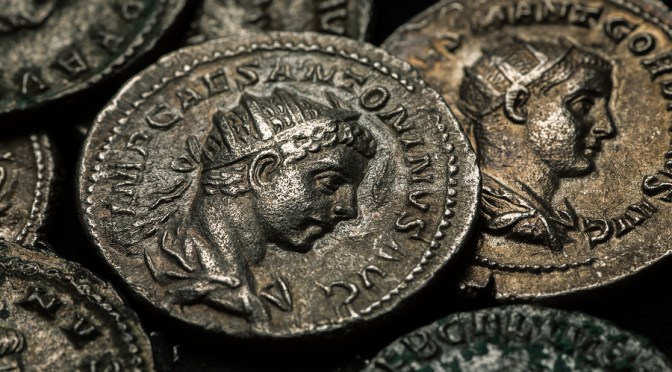
However, the issues with paying taxes to the Emperor had to do with the coins themselves. The Roman Denarius coin bore the image of the Caesar, with an inscription that read “Caesar Augustus Tiberius, Son of the Divine Augustus.” The coin was the symbol of Caesar’s godship.  

Yet, Israelites were prohibited from having any other God’s but the God of Abraham and Moses… therefore to even touch a coin would be sin. And yet, their Roman occupiers gave them no choice, since they all must pay taxes. This is why there were money changers in the temple, sinful Roman money needed to changed into pure temple money. 

The Pharisees were trying to trap Jesus so that they can get rid of him and his enthusiastic followers. 

They were attempting to get Jesus into trouble by making him either choose heresy by denying the one true God or to risk the wrath of the Roman Empire by undermining Caesar’s divinity.

Yet, in the way the Pharisees pose the question the reveal a problem of their own. They reveal their own use of God as an object. Their faith is revealed to be nothing more than a tool to be exploited, a means to obtain power and influence. Being a Pharisee meant status and material comfort. 

The Pharisees might not have even known or seen what they were doing. They had convinced themselves that their objectification of God was true faithfulness. The did not see how they were making everything about their own power and control. 

We don’t have Denariuses with graven images of divine Caesar’s in our pockets, but we certainly try to prop up and hold on to our power and control in the same way.  Christians aren’t above using God is a weapon to condemn and judge others, but more often than not, it is a matter of our trust and sense of security. Like the Pharisees we don’t even see the ways which we place our faith in ourselves, that we seek to control our world in order to protect ourselves from danger and fear. 

Especially during this moment of global crisis, especially when we are being called upon to trust authorities that call us to care for our neighbour and do our part, especially when delusion mad men are on twitter all day and in the news every night spewing lies and hate into air. 

Especially these days, our instincts push us to trust ourselves, and hold on to whatever power we can see, whatever security we can create, whatever delusion might give us comfort. 

It is a very human thing to try to make into God something we own and control and can use for our purposes. And it very human to rationalize acting out in self-interest because it is too hard and scary and exhausting to keep admitted how little control we actually have over the world. 

It is easier to believe the conspiracies about the pandemic, easier to convince ourselves it is nothing, easier to insist on life as normal in whatever ways we can. 

Only to discover that we have lost our way.  

And so when Jesus answer the Pharisees, he points to their contradiction. He asks for a coin… one that the Pharisees should NOT have inside the walls of the temple. (Jesus can be a little cheeky sometimes). 

“Whose head is on this coin?” He says. 

“The emperor’s” they answer. 

And then Jesus replies,

Give to Caesar what is Caesar and give to God what is God’s. 

*Mic drop*

So what belongs to God?

Everything. 

All creation. 

The entire universe.

And what then belongs to Caesar? 

Nothing. 

Jesus has caught the Pharisees in their own trap. 

But more thouroughly, he has made plain their own problems of faith. 

The Pharisees are using God as a tool, a weapon and a trap for Jesus, yet Jesus points them back to God. Reminding them everything belongs to God.

All things. All of creation. All of life. All power and might. All righteousness and virtue. 

And all Grace and forgiveness. All mercy. 

All faith. 

Even us and our broken faith belongs to God. 

But more importantly, giving to God what is God’s is NOT really ours to do. 

Because we cannot give anything to God. 

And that is thing that Jesus has caught the Pharisees with. As they try to trap him, and contain the threat of this ministry, and they try to protect the true faith of Israel, which just happens to give them a lot of power and privilege and wealth… Jesus reminds them their faith, that God is not a thing to control, nor tool to use to maintain their position. 

Rather, God is the one who to whom all things belong. 

And the Pharisees and all Jews knows this, even when they don’t remember it. Because they pray it at every sabbath, and they pray the reminder over and over at passover:

Blessed are you, O Lord our God, King of the Universe. 

And so giving to God what is God’s is truly to be reminded of the God to whom we belong,

is the God of Kings and Empires, of beggars and the lame, of regular folks. 

Giving to God what is God’s is to let go of our hope in ourselves, to let go of our efforts at control and security, to recognize that the power we think we have in this world is an illusion. 

Blessed are you, O Lord our God, King of the Universe. 

Jesus reminds the Pharisees and us that we cannot hold the power of God, no matter how hard we try. 

Rather that The Lord God, King of the Universe is holding on to us. Holding us in our broken, backwards, forgetful attempts at faith. Holding us even as we are surrounded by the dangers and threats of our world. Holding us even though we don’t always see it. 

In fact, our broken faith, our tendency to try to turn God into a tool to use and manipulate is the whole reason God has come. And it is the whole reason that Jesus has ridden into Jerusalem a conquering King and it is the whole reason that soon after the Pharisees ask this question, Jesus will be arrested, put on trial and put to death. 

But the blessed Lord God, King of the Universe is the one to whom all things belong, even death. 

And in death, God shows us that there is nothing that doesn’t belong to God, no place where God will not seek us out, no brokenness that surprises God… and that there is nothing in all of creation that God does not hold in God’s hands. That even death belongs to God. 

And so in pointing the Pharisees and  pointing us back to God, Jesus is also pointing us from death to life. Reminding us that the God to whom all creation belongs has promised us, and our misguided faith, resurrection and new life as well. 

So what belongs to God?

Blessed are you, O Lord our God, King of the Universe to whom all things, including our very selves, our  life, our death and our salvation, belong. 

God’s October (Third Day) Surprise

GOSPEL: Matthew 21:33-46
37Finally he sent his son to them, saying, ‘They will respect my son.’ 38But when the tenants saw the son, they said to themselves, ‘This is the heir; come, let us kill him and get his inheritance.’ 39So they seized him, threw him out of the vineyard, and killed him. 40Now when the owner of the vineyard comes, what will he do to those tenants?”

What a week. 

Unless you live under a rock, the breaking news, local and world events of this week hit us like a torrent of hail. Here in Winnipeg we began by entering into the ‘Orange’ zone because of increasing COVID transmission. Gathering sizes have been limited to 10 indoors and outdoors. Our own cautious plan to potentially begin in-person indoor gatherings for worship has been put on hold for the time being. 

And then on Tuesday the worst United States presidential debate took place, like a dumpster fire inside a car crash inside a train wreck as one commentator put it. Two angry old men took the stage, with one being particularly belligerent and bullying, refusing to denounce white supremacy and seemingly endorsing neo-Nazi groups. 

On Wednesday, the CERB came to an end, with a potentially messy transition of millions of out of work Canadians to Canada Response Employment Insurance programs. 

By Thursday, Ontario and Quebec were introducing greater lock down measures with cases spiking there. And here in Manitoba, the Exposure App came online (make sure you download it!). 

And then by Friday morning, the news came that President Trump and the First Lady, along with some staffers and other legislators tested positive for the coronavirus, shaking a good chunk of the world with a big October surprise… on the 2nd day of October. 

Events that have captured our attention in gripping and anxiety inducing ways. 

In case we have forgotten, this is actually a sermon and not a news report! 

So let’s talk about Jesus then. 

In the midst of all that other stuff going on in the world, Jesus hits us with this curious parable. The 3rd parable in a row about a landowner. First it was the labourers in the vineyard getting hired throughout the day, yet being paid the same daily wage. And then it was the sons who said one thing and then did the opposite. 

And now we get this parable, which is rather nakedly an allegory for Jesus’ own death and resurrection. 

A landowner rented his land to some tenants. When it came time to collect the rent or harvest, he sent his servants to collect it. Yet, the tenants took a wicked a turn and killed those servants. 

So the landowner sends more slaves to retrieve the harvest and again the tenants kill the messengers. 

Finally the landowner deciding he needs to get serious, sends his son. 

It is a curious parable with a curious ending. Certainly, those listening to Jesus would have wondered the same thing that we might wonder. Why would the landowner keep sending messengers. Why not an army? Why not soldiers?

It is a parable where we can see the ending coming a mile away. The son will not fare well. Certainly, Jesus’s first hearers knew that the landowners rationale for sending his son was incorrect. Like when one of the characters in a horror movie decides to investigate the dark basement or abandoned mental hospital… things are not going to end well. 

And sure enough there is no surprise or twist. The wicked tenants kill the son.

But then Jesus asks a question. A question on which the whole parable hands.

“What will the landowner do?” 

I think we know what we would do. The crowds listening say it out loud. 

They think the landowner will answer violence with violence. This is the way of our world. When someone does you wrong, do more to them to make sure they understand their mistake. The punishment must fit the crime. 

There is something about this kind of narrative that grips us. There is something about the power to kill and the power of death that catches our attention. When those first slaves are met with violence and hostility we are hooked. 

And with each wave of messengers, with each response of violence and death on the part of the wicked tenants, we are drawn deeper into the dark narrative. Death has a hold over us, its power both frightens and allures us. But the time the son is sent, based on the flawed thinking of his father, we are caught up in the story even though we know the ending. 

Such is the power of the original sinner within us, the part of each human being that fears and craves the power of death. The thing within us that makes us unable to turn away from an accident scene, from breaking news, from a dark story, with dark twists and turns. The original sinner within both fears death and wishes for its power. We imagine the control we could exercise in the world were we to wield the power of death. 

And so this parable takes us along for the ride, hitting the right parts of our flawed humanity and biological self preservation instincts to keep us rapt.

The parable is almost like different version of our barrage of news this week. Enough violence, drama, suffering and death to keep us glued to screens. 

And yet, the parable isn’t meant to be a litany of things gone dark and wrong. 

For you see, the parable also is supposed to make us think of the other story of a son who is send to wicked people and is killed. 

A story that goes much the same way all the way to Good Friday. 

But that doesn’t end there. 

A story that completely surprises with a twist we would never imagine by Sunday morning. 

The Easter story keeps going. Resurrection changes the game. Life continues on. 

And this parable that we hear today only makes sense with the easter story as the backdrop. 

For you see, as the tenants keep killing and killing. As the hearers of the story keep expected more and more death. God is focused and intent on something else. 

God keeps expecting, hoping for, anticipating life. It seems almost naive. 

The landowner sends more and more messengers and finally sends his son. 

Just as God sent prophet after prophet, messenger after messenger to the people of Israel. God sends messengers and teachers to proclaim life, again and again. To keep calling a death focused humanity to something different, to something new. 

Finally, God sends the son, the revelation of God incarnate. The Messiah who has come to meet God’s lost people, to walk their paths and challenge their death focused ways. 

And when the son encounters the power of death head on… something new happens. The God who keeps expecting life, who keeps expecting something new, shows us a power greater than death, a continuation of the story when there should have been only end. 

And so it is with us during our heavy news week. At a time when we are bombarded over and over with death, with COVID restrictions, with ugly political debates, with shocking breaking news…. God is there in the background, expecting different outcomes. Expecting life, over and over and over again. 

And then when we least expect it, when death seems to have won, once and for all, there is new life. There is a new ending, there is resurrection, there are empty tombs, and there is the realization that death does not have the power we thought it had. That death is not our ending. 

Instead, God doggedly pursues new life. What God has been doing since the begging, chasing after Adam and Eve as they leave the garden, going with Abraham and Sarah into the wilderness, showing the Israelites the way out of Egypt, rescuing the Israelites from foreign occupation, calling for the repentance of God’s people, sending prophets to proclaim a return to God. 

And finally God sends us the son. 

The son that we will surely listen to, but don’t. 

The Messiah who calls out to us, 

who heals the sick, 

receives the poor and down trodden, 

who eats with sinners, 

and frustrates the powerful. 

The son who is nailed, unsurprisingly to a cross. 

And the son who walks out of the grave, extended the story. 

Extending life.

Loosing our grip on death. 

Showing us a new way. 

What a week, we declare today. 

And God responds by saying, 

“Just wait until you see my October, my third day surprise.”

Who Gave You the Authority, Jesus?

GOSPEL: Matthew 21:23-32
23When [Jesus] entered the temple, the chief priests and the elders of the people came to him as he was teaching, and said, “By what authority are you doing these things, and who gave you this authority?” 24Jesus said to them, “I will also ask you one question; if you tell me the answer, then I will also tell you by what authority I do these things. 25Did the baptism of John come from heaven, or was it of human origin?”

“Who gave you the authority?”

A question that is floating around our world a lot these days. 

Our relationship to authority has changed dramatically over the past months. Back in the “before time” it was rare that we had to listen to some kind of authority tell us how to go about some of the most mundane aspects of our lives, from work, to school, to groceries to, to eating out with friends. Now there are now a myriad of authorities that we need to consult  to go about our daily lives, from political leaders, to public health officials, to business owners, to those in charge of organizations and institutions, to the person telling us to hand sanitize when we walk into the electronics store. 

Authority and living our lives by stricter rules then we are used to is everywhere now. How we relate to authority is a constant calculation.

And so here we are, well on our way towards the end of the church year, with Thanksgiving, Reformation Sunday, All Saints and Christ the King Sunday on our horizon. When we would normally be settling into new routines, beginning up with all the groups and activities that we took a hiatus from over summer, and we are instead still stuck in a kind of limbo. Not truly opened up and back to normal and nor truly close down and closed off. Somewhere in between trying to figure what we can do in this new world and what we can’t, and how to stay stay safe and keep our neighbour safe. 

In the midst of this new world, we encounter Jesus being confronted by the elders and chief priests about his authority. About an issue that we know very well these days. 

This confrontation comes in Matthew’s Gospel, it comes from a moment just after Jesus has entered Jerusalem riding a donkey, the prophesied symbolic entry of the promised Messiah of Israel. 

From the cheering crowds, Jesus goes to the temple. The elders and chief priests know what Jesus has just done, they know the crowds have been cheering on this would be Messiah. And they also know that as the official gatekeepers of God for the people of Israel, that Jesus has not been sanctioned by the religious authorities to take up the mantel of the Messiah.

But when the temple authorities question Jesus’ authority, Jesus pushes back. He points them to John the Baptist, who was incidentally the son of a temple priest – one of their own. And Jesus declares that John had baptized or anointed him, much like Samuel had anointed King David. Jesus traps his accusers with a question they cannot answer, because it will either get them in trouble with the crowds or undermine their own authority. 

Jesus exposes the problem of the priest sand elders – their twisted relationship to power. Their motivation to hold onto power and stay in control, their use of the authority of the temple to control the flow of God’s mercy. 

The temple was first built to be God’s dwelling place. To be the place where God’s people would come to receive God’s grace and mercy, to receive forgiveness of sins. And the point of the temple was not to control God’s mercy, but to provide it. To hand it out. To make sure that God’s people could go and receive in concrete and tangible ways, That they always had access to God’s mercy.  

Yet, as it often seems to be with humanity, we like to turn points of access into checkpoints and bottlenecks, into points of control and power.

And now Jesus has become a threat to the temple cult, to this carefully crafted system that had been devised and shaped for centuries. 

Instead, Jesus was giving access to God out in the world, without the proper authority, without the proper control mechanisms. 

Jesus was undermining the whole system, upending the power and control of the temple leaders had over the people of Israel. 

Today, we certainly don’t hold that kind of control over people as the Church, at least not in 2020. There have been times over the past 2000 years when the Church has constructed systems of power and control around access to God – as Lutherans we were born out of such a moment in time in the Reformation. 

But these days, our place of authority in this world is quite different. We are increasingly being relegated to margins of most of public life. 

Yet, our understanding of authority and desire for it is not that much different than that of the temple cult of Jerusalem from 2000 years ago. 

Somewhere along the line we too have begun to confuse access to God’s mercy, with power and control over the world around us by gatekeeping God. 

We may not exert the same influence, yet still we long to. As churches well into the 21st century, often struggling with our place in the world, it is easy for us to believe that if we only need our authority back, our power and influence over the lives of people around us. If only Sundays could be kept free of sports, shopping and dance lessons, people would have to come to us. If only we had more money flowing to our offering plates, more staff carrying out our programs, more people to serve on committees, we could be an institution of importance again. 

As human beings, we often believe that more authority, more power and control, will bring more security, more comfort, and make our lives easier. 

And yet, as we watch the pharisees tie themselves in knots working to maintain their power and authority, we know that it is the same for us. That seeking out authority and influence, power and control only makes life more difficult. 

As Jesus responds to the elders and chief priests, he puts them on the spot by forcing them to choose between angering the crowds or undermining their own influence. So they choose neither. 

And you can see the math going on their heads. If they give up power and authority, than Jesus will gain it. They fear an inversion of the status quo, where all the folks at the bottom will wind up at the top, and the folks on top will fall to the bottom. 

Yet, Jesus isn’t seeking a power inversion, he isn’t looking to take the authority of the temple away from the elder and chief priests, at least not directly.

As Jesus continues to speak, he tells a parable about two sons who say one thing and do the other. But it is Jesus declaration that follows about who will gain access to the Kingdom of God that reveals what Jesus is up to. 

Jesus subtly names who is the source of that authority and what that authority is doing in the world. 

Jesus hasn’t ridden into Jerusalem to turn the existing power structures upside down, but to do away with them entirely. 

Jesus is reminding the temple authorities, that their job is not to withhold God’s mercy but to make sure God’s people receive it. Jesus is reminding us that his is out job too.

Because God isn’t putting authority and power into the world, God’s Kingdom isn’t about creating structures for human beings to exploit. 

God is the source of is mercy, love, compassion, and grace. 

God is putting hope and promise into the world. 

Hope found in the Messiah who meets humanity in flesh. 

Promise that the powers and authorities of this world are not the ultimate ones. 

Compassion given through disciples delivering good news in word and action. 

Love granted by the nearness of Christ to God’s beloved children. 

Mercy for the suffering and down trodden given by the Messiah who has found a wayward creation. 

And Grace, Grace on its way, on its way to Good Friday, on its way to that morning of the Third day. 

God is in our world filling it and us with the power of life and new life found only in God. 

And so as we crave influence and control of the world around us, as we wish for just enough power to be comfortable and to not have to worry… 

Jesus still brings us the good news of forgiveness for sinners, mercy for the suffering, and life for the dying anyways. 

The church may never be as powerful and influential as it once away, we may never be an important authority in this world again in our lifetimes… but God the gospel of Jesus Christ, the good news of God’s love for all of creation and for us….

That is as authoritative as it has ever been, that is the root and source of the power of the Church, of the Body of Christ out in the world. 

“Who gave you the authority?”

This is perhaps the question of our time. 

And the answer is found in the grace and mercy of God, given to us in Christ. 

Guaranteed Basic Grace

GOSPEL: Matthew 20:1-16
[Jesus said to the disciples:] 1“The kingdom of heaven is like a landowner who went out early in the morning to hire laborers for his vineyard. 2After agreeing with the laborers for the usual daily wage, he sent them into his vineyard. 3When he went out about nine o’clock, he saw others standing idle in the marketplace; 4and he said to them, ‘You also go into the vineyard, and I will pay you whatever is right.’ So they went. 5When he went out again about noon and about three o’clock, he did the same. 6And about five o’clock he went out and found others standing around; and he said to them, ‘Why are you standing here idle all day?’ 7They said to him, ‘Because no one has hired us.’ He said to them, ‘You also go into the vineyard.’

Today, as we continue into the second half of this long season of green, we hear a familiar parable. The parable of the landowner and day labourers. 

It is a familiar parable for most folks who have spent years sitting in pews, listening to sermons on the parables of Jesus. This parable caught my attention from an early age. I can picture sitting in church as a child, hearing the pastor talk about this story… even when listening to sermons wasn’t all that interesting to me yet. The way it sets itself up to challenge our assumptions, even when we know the story. The upside down way it treats how the world is supposed to work. They way it speaks to ancient labour practices and yet still seems so applicable and current with the way we understand work today. And the familiar indignity of the workers who worked all day contrasted with the surprising generosity of the vineyard owner. All of these parts of the parable grab us every time we hear it. 

But these days we have new ears to hear and the parable comes to us from a different place and with different questions and challenges for us. So much of our focus is on the dangers and risks around us in the world. We hear about massive fires burning far, far away but still sending smoke our way. We read the news about outbreaks at schools in our neighbourhood community. We get blasted with the constant election coverage of our neighbours to the south and the election question is being asked of our own government. 

This is a parable that points back to so many of the questions we have faced in the past few months and questions that we are about to face in the coming ones. Questions about privilege, equity and equality, question about justice and human dignity.

When we hear the parable again today, we remember the familiar elements. The landowner hiring workers for his vineyard. Early in the morning, again at 9, in the middle of the day, at 3o’clock and against just before day’s end. We envision this well-to-do landowner coming back again and again to the marketplace, the agora, the centre of a town’s economic and social life. 

The day labourers are waiting for work, just as they probably did each day. They waited in the marketplace, hoping to be hired for the day so that they could earn enough to support themselves and their families. The basic currency of that world, the Danarii was based on a day labourer’s wage. Enough money to pay for food and shelter for one day. 

We don’t have many similar systems here in Canada, but if you know the right places to look, you can still find day labourers. The first time I saw a group waiting for work as when I was a teenager. Our church youth group travelled to San Diego and then across the border to Tijuana to build houses in Mexico. We stopped at a Home Depot to pick up some supplies  and there was a group of men waiting to be hired. As we sat in the van while leaders went into the store, we watched as pick-ups pulled up to the group waiting on the sidewalk. The drivers would call out a number, and the equivalent number of workers would hop in the back. 

The first part of the parable would have been a common and easy to understand circumstance for Jesus’ hearers. A landowner goes a hire some labourers first thing in morning, discovers after the a bit, the harvest isn’t progressing quickly enough, so goes to get some more. 

But once the owner goes back a third time at noon, this should be setting off our spidey sense. It would be strange to go a hire labourers for half a day, and strange that the labourers were still waiting at noon. 

Still the parable gets more strange. The landowner keeps going back, at 3 and 5 o’clock. Why would he keep hiring? How much work could those latecomers do? And why were they still waiting, who did the labourers think would hire them in the middle of the afternoon and at day’s end?

But then we get to the important part. The part that we cannot help but identify with. The part when the landowner pays all the workers the same wage. 

There is a part of us that enjoys the indignity of the full day grumblers. We identify with these ones, the ones who feel entitled, who have worked all day and recognize what they have earned. Even if landowner doesn’t pay the extra, the grumbling workers know they have earned more. 

They see themselves as the dedicated hard working ones who have put in the time and should reap the reward. 

And nearly every sermon I have heard on this parable admonishes faithful Christians in the pews not to complain (even if deserved because of hard work) about those who might come to faith a the end…

Yet, certainly this year, this chaotic and unprecedented 2020 year with natural disasters, protests against racially motivated police violence, and a pandemic… certainly this year is challenging our established understanding of this parable and ourselves. 

It is easy for us to think we are the hard workers and the others are the lazy ones looking for a free ride. We rarely attribute our situations to opportunity and good fortune. 

Surely, the grumbling workers knew what is was like to be passed over for work. Surely they knew what is was like to wait in the marketplace for the chance to feed their families for another day, only to wait and wait and wait for nothing to come in the end. 

Surely, they could see that the latecomers where not lazy layabouts who are taking advantage of a generous landowner, but rather that the early workers were the lucky ones, the ones who could rest easy for the day knowing they their needs would be provided for, that their families would have roofs over their heads and food in their bellies. 

If this global pandemic has taught us anything about fairness and privilege, it is often those who are perceived as lazy and taking advantage are often the least advantaged and some of the hardest working. We have see many all of sudden be without work and have nothing to do but wait. We have seen how it is often the poorest least advantaged who are forced to work the front lines of a pandemic world. 

And we have heard our own Lutheran Bishops, along with Anglican Bishops write political leaders in support of Guaranteed Basic Income, which is receiving a lot of attention in the news, in legislative halls and around kitchen tables. As the CERB, the Wage Subsidy and other programs kept food on the table and the lights on… we have discovered that there is a lot of luck when it comes to earning a living and hard work is no guarantee that you will have enough. 

And so as the workers who worked all day grumble about not getting more than they needed and agreed to work for, the landowner replies to them,

“Am I not allowed to do what I choose with what belongs to me? Or are you envious because I am generous?’ 16So the last will be first, and the first will be last.”

The landowner, the one standing in for God challenges the perspective of privilege and entitlement. The landowner challenges it with generosity, with a generosity that gives not based on merit and worth, but based on need. The landowner provides all the workers, the lucky ones who were picked first and the ones who had to wait all day, enough. Enough to eat, enough to feed their families, enough to live. 

Guaranteed Basic Grace. 

This challenge to the way we understand the world works, this reminder that hard work is often born of opportunity and circumstance and that those who are left to wait and who are left out are the unlucky ones. 

And yet Jesus’s challenge to us also reveals the generosity and abundance of God’s grace and mercy given for us. 

That God’s approach to us is not to measure us by our hard work or merit, not to give us what we deserve… because we are certainly all lacking and all fall short. 

Rather God’s approach is to give us what we need. To show us the mercy and grace that will get us through to another day. God’s approach is to extend life where there only seems to be death. Where there would have been empty bellies and unsheltered heads, God extends life once more. 

God’s way with us is to keep life going, to give us one more day. One more day that carries us to the third day, to the day of resurrection, to the day of grace and mercy when life extended.  indefinitely. 

And this year, God has challenged our sense of fairness, our understanding of opportunity and privilege. God calls us again to consider not what each one of us is worth nor what we think we deserve…. But to consider what each one of us needs. And God reveals the generosity that is given to us. 

And however unfair that feels, God gives all the grace and mercy needed for one more day and for life eternal in Christ. 

Having only Bad Choices – God’s Third Option

Matthew 18:21-35
21Peter came and said to [Jesus], “Lord, if another member of the church sins against me, how often should I forgive? As many as seven times?” 22Jesus said to him, “Not seven times, but, I tell you, seventy-seven times.
(Read the whole passage)

I wonder what was going through the minds of the Israelites standing on the banks of the Red Sea… an army chasing them down from behind and turbulent waters ahead of them. No good options, only bad ones. 

Here we are, into month 7 of this global pandemic, and it feels strange to be preaching again about a virus… and yet this illness that spreads so easily and makes just enough folks really sick has changed life and the way we live it. It is in the news every day, it has become an important factor in nearly every decision we make from how to buy groceries, to visiting with family, to going to work or school or even coming to church. 

We have been walking along side the stories of God’s people during this entire pandemic in a new way, a way different from before when we likely felt degrees of separation from the struggle. Again and again we have found the world and story that we have been living out in real time is one that is already told and experienced in the bible. From Abraham and Sarah and their descendants making their way in the wilderness, to the disciples cluelessly following Jesus, to Moses and the Israelites preparing to escape Egypt. 

We are firmly in the back half of this long season of green. 15 Sundays into Ordinary Time, and there are only ten or so left before we flip the calendar on a new church year in Advent. Yet, even now, those ten weeks seem like they are still a lifetime away, the predictability of our lives has been taken from us as we wait each day to hear whether or not this pandemic thing is getting better or worse. 

Along side the the story of the Israelites feeling Egypt’s armies and crossing through the parted waters of the Red Sea, Peter asks Jesus how many times ought he to forgive. Peter’s guess was a number he thought to be quite generous. 7 times. But Jesus responds by multiplying that number 70 times 7. Which is not to say 490 times, but forgiveness ought to be offered more times than Peter imagines possible. 

There is something about the Israelites standing on the brink of destruction or disaster that goes with Peter’s question about forgiveness. 

As the people of Israel, the community of God’s people stood there on the banks of the seashore, the feeling of helplessness and defeat must have been overwhelming. There was no good choice to make, only bad options. Options that both include death for many. Death at the hands of Egyptians soldiers, or death in the waters.

In the same way as Peter considers forgiveness, he too stands between hard choices. Forgiveness really exists at the edge of a difficult choice, to let go of harms and wrongs done. Does forgiveness condone bad behaviour? Does it simply allow for more harm and abuse? Or does not forgiving hold us in bitterness and judgment, in resentment and anger? There is no easy answer or obvious choice. 

The people of Israel and Peter are standing at the precipice of bad options and choices all around. Not dissimilar to where we are stand theses days. We too have been struggling with how to move forward in life when there are are only bad and unsatisfactory options all around us. Do we stay home or risk seeing family and friends for the sake of mental health and wellbeing. Do we go back to workplaces and jobs risking exposure but needing to support businesses and the economy? Do we send children to school with untold numbers of contacts or do we risk their growth, learning and development. 

And of course, do we begin gathering in-person for ministry and worship as churches once again? Is the community that we share in this place worth the risk of transmission? Do the restrictions placed on how we worship (masks, no singing, no visiting, socially distant and brief) justify the effort to be together inside of a beloved church building and church home?

Today, the Lord God of Israel and Jesus the Christ offer third options. A parting of the waters, a new and unexpected pathway to salvation. An understanding of forgiveness that expands far beyond what seems generous and reasonable at first. 

Yet, as Moses raises his staff and hands over the sea and the waters part… I am not so sure that stepping into the newly revealed sea bed would have felt any safer. I don’t think I would have been the first to follow the path between the two walls of water, not knowing if or when they might come crashing down. Salvation and rescue doesn’t always feel low-risk and secure. Being safe isn’t always comfortable.

Yet, as Jesus speaks of forgiveness beyond what Peter can imagine, forgiveness that is not just generous but abundant and lavish. Forgiveness that extends beyond close friends and family, that is given for the whole community, for all of creation… I am not sure I would want to walk away from the ability to hold others accountable, to hold them in my judgment… who knows how that might be taken advantage of. Letting go my judgment and resentment doesn’t feel natural or straight forward. Setting feelings and gut instincts and coping mechanisms aside isn’t easy. 

Yet, the Lord God of Israel brings the people through the waters to safety to other side and on their way to the promised land. 

Yet. Christ goes to the cross and even while hanging there in the final judgment of humanity, prays for mercy and forgiveness for all of us. 

For you see, God reveals something beyond our impossible choices, beyond the risk of armies and raging waters. God pours out forgiveness, release from judgement and condemnation that cannot fathom. 

God invokes options and futures that we cannot conceive of. Christ shows us the way to abundant new life beyond ourselves, and beyond what feels safe. 

And for us, for the church as we face a world full of bad options, full of risks and stress and anxiety about what the right thing to do is, God is working among us already, parting waters that will send us on our way to the promised land – there just might be 40 years in the wilderness first. 

And Christ is exhorting us to forgiveness knowing that resurrection and new life have begun already in our world, even if the cross of Good Friday comes first. 

God in Christ promises that even through this pandemic, even through the separation of communities, friends and family, even through the limitations on the way we worship and the way we can gather… that the transformation and salvation of God’s people has already begun… that there will be parted waters ahead for us, that there’s abundant forgiveness waiting for us… that a new way of living and being in the world for this pandemic church of 2020 is on its way. 

We might feel stuck to between bad choices theses day, but God is with us, God is beside us, God is among us… carrying us to the new and unexpected thing that we cannot imagine yet. 

Because God has already brought God’s people, and will bring us, through the struggle and to the other side, 

to the promised land 

of mercy and new life.