All posts by The Rev. Erik Parker

iPhone Pastor for a Typewriter Church. Blogger, Podcaster | High Church Lutheran | Husband & Dad | Oilers fan in exile | He/Him

Confessions of a High Church Millennial – 10 Ways I am grounded by Ritual, Liturgy and Tradition

I haven’t confessed this to you in a while, but I am still a High Church Millennial. Just because I often wear jeans on office days, have tattoos and an apple music subscription on my iPhone… doesn’t mean I don’t love old things. And not looms, vinyl played by a gramophone and artisanal vegetables as the caricature of a millennial hipster goes.  I love ancients things like ritual, liturgy and the traditions of Christianity.

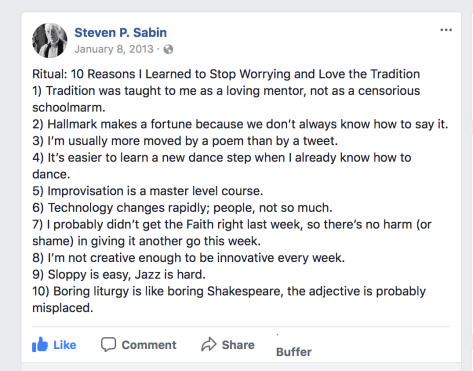
So recently, as I went about my normal perusal of social media, I came across the post of a pastor friend. The Rev. Steven Sabin serves in San Francisco, and he thoughtfully wrote the post pictured below:
Screen Shot 2018-01-16 at 11.27.18

I love the way Pastor Sabin describes his experience of a high church faith. I can see my own experience in his post. And as many churches search for ways to get “the young people back” with the newest and flashiest toys, gadgets, fads and entertainment…. let me tell the story of why this millennial would rather have the old things and the deeper meaning.

*Note: I skipped a few of Pastor Sabin’s points.

1 Tradition was taught to me as a loving mentor, not as a censorious schoolmarm.

I grew up in a world where tradition was shunned and Lutheran liturgy was like eating vegetables… you did it but no one liked it. Our worship was often treated as if it was a list chores to do every Sunday morning. And then our church hired some musicians to help plan our liturgy and music. And for the most part, the congregation continued to feel the same way about liturgy. But as a teenager, I noticed that suddenly worship became a more cohesive experience. The list of chores transformed into the script and stage directions of a beautiful play. There was movement, there was purpose to our worship, the music connected to the prayers, the prayers connected to scripture, the biblical texts connected to the eucharist and so on and so on.

When I went to seminary, I was finally taught the finer and detailed points of the ritual I had been enraptured by. Liturgy for me now is not a burdensome set of rules to follow and chores to do, but a ground to stand on in worship, guiding the assembly into deeper meaning and a deeper experience of the divine… proclaiming the gospel and inviting us into the body of Christ in a way that no other worship form can do.

2 Hallmark makes a fortune because we don’t always know how to say it.

One of the things I cling to as a preacher and presider is that when the words of my sermon fail, then the words of the liturgy say what needs to be said. And knowing that Christians around the world and through the centuries have used these same words gives them a sense holiness and authority that spontaneous and unprepared words lack.

3 I’m usually more moved by a poem than by a tweet.

There are such things as twitter poets, yet even they recognize the limitations of the medium.

A tweet is an ephemeral abstract thing. Most tweets rarely have a long life, they come at us quickly and in high volume. Great for breaking news, but lacking the deliberately slow and considered words of a good poem. Poetry is intentional and reflective. Poetry is an economy of words not because there are only 140 (or 280) characters, but because every word matters. The same goes for the liturgy.

4 It’s easier to learn a new dance step when I already know how to dance.

I recently moved from leading worship in 1 congregation to 5. While each congregation has its own particularities, it is the commonality of the liturgy that makes it possible smoothly step in to preach and preside each week. The order, the movement, the rhythm is all familiar, even if a few steps are different.

6 Technology changes rapidly; people, not so much.

There are a lot of things that are rapidly changing in my millennial world. Social media flies by rapidly each day. The way people communicate with me has changed dramatically over the years. 65 year olds used to phone my landline but now text me when planning a funeral for the parents, 30 something colleagues let me know about job opportunities in facebook groups, even my 96 year old grandmother talks to my kids on FaceTime now and then.

But worship, the familiar words, patterns, seasons, texts and emphasis is one of the grounding forces of my life. I more easily associate significant memories with the liturgical season they occurred in rather than with date and month. Each week, I find my grounding and footing again in the familiar and stabilizing experience of the liturgy in the assembly.

7 I probably didn’t get the Faith right last week, so there’s no harm (or shame) in giving it another go this week.

I am coming on 9 years of ordained ministry. I probably surpassed 500 times presiding in worship recently, and I still feel like I am just starting to scratch the surface or the depth of the faith. Maybe 40 more years and I will feel like I got it right… but I doubt it.

10 Boring liturgy is like boring Shakespeare, the adjective is probably misplaced.

Being bored is usually a sign of not understanding what is going on. I grant that the church and pastors have not always been very good a teaching the liturgy and tradition of the church. But the best way to learn is to experience. We live in a world that says we are all experts before we begin… or should be. The liturgy is rich and deep and complex and beautiful. And it can be confusing if it is unfamiliar. But what form of unfamiliar worship wouldn’t be confusing? The best way to learn is through repetition. Try worshipping in a liturgical church every week for a year, and then how liturgy feels. If you find yourself bored, perhaps it is because there is learning that needs to happen. Talk to your pastor, they might be able to help.

Now, make no mistake Liturgy, ritual and tradition are not the newest (or oldest) gimmicks to get millennials back to church. Rather they are just servants of the gospel, the vehicles through which we regularly encounter God as people of faith. And it is meeting and following Jesus that is the most important thing – the most important thing that we do, and that worship helps us to do, as people of faith.

So as I said, I am still a High Church millennial. And it is these ancient things of liturgy, ritual and tradition – and how they so clearly proclaim Christ crucified and risen – that are the reasons I am still in the church.


*Thanks again to The Rev. Steven Sabin for allowing me to annotate his great post.

The Overturned Household of God

John 2:13-22

The Passover of the Jews was near, and Jesus went up to Jerusalem. In the temple he found people selling cattle, sheep, and doves, and the money changers seated at their tables. Making a whip of cords, he drove all of them out of the temple, both the sheep and the cattle. He also poured out the coins of the money changers and overturned their tables. (read the whole passage)

“Stop making my Father’s house a marketplace!”

There is an irony when it comes money and determining the value of something. As soon as we try to sell something, we cheapen it. Sellers will ask, “How much can I make from selling this thing”. Buyers will say, “How little can I pay to obtain the thing I want”. And maybe that is why money can be such a touchy subject, maybe that is why when we as human beings talk about money we talk about it more seriously than anything else.

You can watch the nightly news and a story about war or disease or crime or death can be reported with great gravity and then followed by a lighter story about celebrity, or charity or human interest which is reported with a smile and a laugh. But watch the business news, and every story is treated seriously and like it is important.

All the seriousness almost seems like an attempt to mask the shame and guilt that money invariably brings into our lives. We know that we like money and that makes us greedy, and we know that greed is a shameful thing to be or to feel.

Did the money changers and animal sellers feel that shame when Jesus came barging into the temple?

In our churches today, we do not really know the situation that Jesus was walking into. Imagine if when you arrived at church this morning, you had to pay to park, and then pay again to get through the doors. And then once inside there were some police officers milling about, some county employees and some church council members selling things. In order to worship you would have to rent your hymn book, pay a ticket to sit in a pew, buy the water if you needed baptism, buy the bread and wine if you wanted communion.

And then if you wanted to give 100 dollars to the church, you had to pay 115 to change your money into church money.

This is what the temple in Jerusalem looked like. More like a busy shopping mall than a place of worship. Anyone who was poor had no chance of making it in. Those who had a little money had to save up for years, and the rich would come and go as they please.

The temple priests were skimming off the top all the purchases made. The Romans were taxing all the profits. And the people selling the doves, sheep and cows for sacrifice weren’t even jewish.

You could imagine why Jesus would be upset with what was going on in the temple. The whole point of the temple sacrifice system was to make God’s forgiveness more accessible. The job of the priests was to preside of sacrifices and show people a visible sign of God’s invisible promise of forgiveness. Yet, what had been designed to be accessible had become inaccessible. Worse yet, what was supposed to be a way of freely giving God to the people had become a way of selling God for an exorbitant rate.

Martin Luther had the same problem with the Roman Catholic Church, who was selling God’s forgiveness and early exit from purgatory in the form of indulgences.

Now, today as you came into church, you probably didn’t worry that you would have to buy your way in. We might feel like we can look back and say we have figured it out, we aren’t so foolish as to sell God.

Granted, there are still TV evangelists selling little green cloths and the promise of healing. But in a way this is more honest than what most North American Christians have been doing for a long time.

Jesus was upset with people for trying to make a profit off of God. To sell God’s love for price. To sell something that is priceless and more valuable than we could ever afford, for a few coins.

But like most things, North American Christianity has taken the marketplace of the church to a whole new level.

We aren’t so crass as to sell God. We have found a much more slick and devious way to make a profit off of God. Most churches today will preach that God’s love is free gift, but then they will go on to say that if you are good enough God’s love and blessing will make you rich. Forget trying to earn and pay for a little piece of God, instead let’s put God to work for us! All we have to do is pray hard enough, believe sincerely enough, act pious enough. And then God will bless you with health, wealth and happiness.

If Jesus were to come and over turn over our marketplaces he would have to come into our homes and work places, he wouldn’t tell us to “Stop making my father’s house a marketplace” instead he would say, “Stop making my father’s love a way to get rich!”.

So…does anyone know what the word “economy” means?

In modern terms, it is the resources and wealth of a country or region. But Jesus actually uses the root word for economy as he speaks today. “Stop making my Father’s house a market place”.

Oikos in Greek. House in english. The greek word of economy is oikonomos, which means to manage one’s household.

The economy is caring for the household and all that is within. The people, the resources and the wealth. Our economy is our household wealth. The word economy is related to other words we know.

Ecology, the care of the household of the earth, or the environment.

Eccumenism, which is relationships between Christians, Lutheran Catholics, Anglicans, Baptists, Pentecostals etc… The care of the household of faith.

“Stop making my Father’s house a marketplace”.

Jesus is suggesting a different economy. Jesus is declaring a new way to manage God’s house. In our economies we buy and sell, we make money and lose money.

But in God’s house, everything is free. God’s forgiveness is freely given. And Jesus’ promise is for everyone. God’s new management system is on its way.

But the priest and temple authorities challenge Jesus’ declaration of a new economy. We challenge Jesus’ declaration of a new way to manage our households. We know that nothing is free, everything costs. We like knowing this because it gives us control, we know what we need to do to earn God’s love. We know that we have to be good, follow the ten commandments, pray hard enough, read the bible enough. As Lutherans we know that we need to attend worship once a year, take communion and give some amount of money to the church.

But Jesus doesn’t care what we know. Jesus is making it all free. Jesus is making it all priceless. And Jesus knows that this radical new system will only lead him to death, he is on his way to the cross. “Destroy this temple, and I will raise it up in three days”.

The temple is God’s dwelling place, it is God’s house. And yet Jesus is speaking about himself, he is pointing to what we will do on Good Friday “Destroy this temple”. And he is promising what God’s response will be, “I will raise it up in three days”.

We dislike the idea of God being free so much that we will treat Jesus like a criminal, kill God in flesh, and destroy his temple, his house.

Yet, God’s new economy, where forgiveness, grace and love cannot be sold or bought is on the way. God’s new economy that responds to power and fear with weakness and intimacy is on the way. God’s new economy that encounters death with new life is on the way and is promised to us.

Today, Jesus tells us that everything we thought had value is worthless. Power, money, death.

And everything we thought that was of no value, weakness, poverty, life. These things are the new way God is going manage our economy, our households. God is giving away love, mercy and forgiveness for free. And that is turning our world upside down.

The Resurrection of the Wedding of Cana

John 2:1-11

1 On the third day there was a wedding in Cana of Galilee, and the mother of Jesus was there. 2 Jesus and his disciples had also been invited to the wedding. 3 When the wine gave out, the mother of Jesus said to him, “They have no wine.” … (Read the whole passage)

As we begin our journey into the gospel of John, we move on from the big celebrations of Christmas, Epihany and finally the Baptism of Jesus. Today, we are back to green – ordinary time or counting time. And we hear a story with a little less drama than what took place on the banks for the Jordan. Yet, a familiar story none the less.

The wedding of Cana.

Jesus’ first miracle of his public ministry. Its a famous story about a relatively happy, generous and harmless miracle. Turning water into wine is like moving a child’s birthday party from the local public pool to the expensive and fact waterpark in town! It sure does ramp up the party, but in the end it is still swimming.

Today, John carefully mentions twice that Jesus attends this wedding celebration in Cana of Galilee. Galilee a poor province next to Jerusalem, full of thieves, bandits and gentiles. People who were ignored and forgotten by the rest of the world. And here in Cana, a small village of no consequence, Jesus is attending a wedding. A wedding party that is supposed to last 7 days, yet during which the wine runs out before its time for it to be over. And while running out of wine would be a source of shame for the wedding hosts, the father of the bride in particular, it was probably not an uncommon experience. In the subsistence world of first century Israel outside of Jerusalem, most small communities like Cana were collections of people just trying to make ends meet. If hard, back breaking work meant that you could earn enough or produce enough to buy food and shelter, pay your taxes and debts and care for you family… you were doing pretty well.

Having extras for weddings was an extravagance. So entire communities likely came together at times of celebration. If everyone contribute something, there was probably enough for a party. And the party lasted as long as the wine held up.

The wedding in Cana was probably for someone who was a relation or family friend of Jesus. Mary, his mother, is at the wedding. So are Jesus disciples… when there was a wedding in a town like Cana, everyone attended, local or foreigner.

And so with extra out of town guests, and the relative poverty of the townsfolk, it is not surprise that the wine ran out.

Mary thinks that something should be done, she tells Jesus and his response seems almost rude, “What concern is that to you and me?”. He seems to be saying, “Why should I care? Who cares about Cana in Galilee, its in the middle of nowhere! Who cares about this wedding? Does it really matter if the party ends early? Does we really need a little more wine?

For us in the 21st century, running out of food or drink at such an important celebration as a wedding is a major faux pas. Someone should fire the wedding planner or get a refund.

But we shouldn’t get too caught up on the details of the wedding or the wine.

Because we DO know what it is like to run out. To run out of time, run out of options, run out of opportunity. Run out of energy.

It isn’t wine at a wedding that run out of, but it might be money at the end of a paycheque.

We might run out of time to spend with our spouses or kids at the end of a long work day, or time to spend with grandkids at the of a short once a year visit.
We might run out of treatment options at the end of a battle with disease or illness.
We might run out of chances to fix a broken marriage or relationship or friendship.
We might run out of time to get our affairs in order or make our own decisions before the health crisis hits.

Like those wedding guests in Cana, we know very well in our world what it is like to run out, to not have enough, to be bound by limits and walls, for death to be the thing always waiting for us.

The wedding of Cana is our world, we live it every day. The wedding of Cana is not unusual because wine ran out… in fact, it is was probably like every wedding to come before it.

The wedding of Cana is not unusual except for Mary.

Because Mary knows something that no one else knows.

When she tells her son Jesus that the wine has run out, she isn’t doing it as a micro-managing mother. She is pleading with him as someone who knows that things can be different than the norm. That endings and limits and running our and death doesn’t have to be the way it is.

She knows that with Jesus the world is different because she has lived it. She has been given the death sentence of a pregnancy outside of marriage, yet her world kept on.

So when the wine runs out, maybe she is looking to Jesus for a different world. For a world where we aren’t defined by not having enough. She is pleading for a glimpse of the new creation of Messiah.

Jesus might not respond in the most kind way, but perhaps there is something in his mother’s face… the realization that his hour has indeed come. That his hour came back in the beginning. Back when the word became flesh.

So Jesus tells the servants to fills the water jars….

And the water becomes wine. Its a wonderful gift that Jesus bestows on this wedding… but the wine itself is only one part of the gift that is given. No one else seems to realize what has happened for this small and poor wedding in the middle of nowhere is that God has stepped in.

God changed the normal outcome.

God has changed the ending that we know, the ending of running out, of limits and walls, the ending of death.

And Jesus brings the wedding back to life. You could even say the wedding of Cana was the first time that Jesus raised something from the dead.

It just a foretaste, hint, a glimpse of what is to come, but the wedding sets the stage. Jesus isn’t just correcting some poor wedding planning, or taking mercy on hosts that had more guests show up than they anticipated.

Jesus is changing the normal order of the world. The order where death always wins, and Jesus creates new life where there was nothing before… just as God first created life from nothing.

And as the wedding of Cana is transformed and raised to new life… so are we.

So are we week after week.

As endings and limits and walls and deaths punctuate our lives, Jesus transforms us. Not be putting a few more dollars in back account, or longer work days, or shorter distances from loved ones, quick fixes for broken relationships, or better health and ability in the midst of aging and decline.

Jesus turns our endings, limits and death into wine week after week, Sunday after Sunday.
Jesus turns the endings of our brokenness and sin into forgiveness and mercy
Jesus turns the endings of condemnation into the good news of God’s love for this world.
Jesus turns the ending of not-enough into an abundance of bread and wine.
Jesus turns the endings of death into new life.

Jesus gives us the first miracle of the gospel of John, the wedding feast of Cana where they ran out of wine…. but a story of death and resurrection.

The first miracle which foreshadows the end… the last miracle
Miracles that both take place on the 3rd day.
And a woman named Mary being the first to find what is empty.
And empty wine jars pointing us to an empty tomb.

In the Weeding of Cana, the first miracle of the gospel of John, the Messiah, the one who changes the order of our world, the one who brings – to a world of endings, limits and death – resurrection and new life.

“What are you looking for?” asks Jesus

John 1:35-51

35 The next day John again was standing with two of his disciples, 36 and as he watched Jesus walk by, he exclaimed, “Look, here is the Lamb of God!” 37 The two disciples heard him say this, and they followed Jesus. 38 When Jesus turned and saw them following, he said to them, “What are you looking for?” They said to him, “Rabbi” (which translated means Teacher), “where are you staying?” 39 He said to them, “Come and see.” (Read the whole passage)

John the Baptist just won’t go away. He showed up for a couple weeks in Advent, took a break over Christmas and then showed back up today. John is again pointing to Jesus, and proclaiming the coming of the Messiah.

Now this story about John pointing out Jesus to his disciples might sound a little unusual today, because it is the day of the Baptism of Our Lord. We are hearing it because in Interlake Shared Ministry congregations we are beginning the use of the Narrative Lectionary for 3 months as way of doing something together that is a little different and that will remind us when we gather for worship that we gather not to ourselves, but together as a unified ministry across the Interlake.

Now the focus of the Narrative Lectionary for this three month period is the gospel of John… and John’s gospel has a quirk when it comes to the baptism of Jesus – John omit’s it.

Matthew, Mark and Luke all treat it a little differently, but they all tell the story. However, John tells all the little stories around the story. He talks about John the Baptist preaching at the river, he tells of the crowds coming to hear. He talks about the interactions between John and his disciples, who would eventually become Jesus’ disciples.

But there is no actual baptism… the writer of John’s gospel was writing for the early church community who was in a debate with the followers of John the Baptist about who truly was the Messiah, John or Jesus. The fact that John baptized Jesus was a little inconvenient to that conversation.

Never the less, the first readers of John’s gospel would know the story of Jesus’ baptism, and hearing these side stories, they would immediately bring that well known story of the spirit descending on Jesus and a voice from heaven declaring, “This is my son the beloved, with him I am well pleased.”

And yet, these side stories of the gospel in many ways still tell the story of baptism. They tell a story of call and transformation.

The story picks from where we left if off in Advent. John was talking with the pharisees and temple authorities about who he was, Messiah, Elijah or the prophet.

The next day John is back at the river again and Jesus walks by John and John’s disciples, John reminds all who can hear, that this is the Lamb of God, the Messiah. And so John’s two disciples decide to follow Jesus, presumably they are looking to see what this Jesus guys is all about. It isn’t long beforeJesus notices their interest. He stops, turns and asks them “What are you looking for?”. It is an open ended question.

Maybe these two disciples simply want to know what all the fuss is about or to see a show in case Jesus decides to perform a miracle. Or maybe this question has deeper meaning.  “What are you looking for?” Perhaps we should consider the asker. Jesus, the one who John has proclaimed to be the Messiah, the Lamb of God is asking. Jesus, the one who we believe to be God, the second person of the Trinity is asking. And where one person is, so the other two are also. The God and King of the universe, the Father, Son and Holy Spirit is asking, “What are you looking for?” So, what would is there to answer? Happiness and Wealth? Love and family? A Long life? Peace in a violent and sinful world? Food for starving children? Cures for cancer, AIDS, Leprosy, yellow fever and heart disease? An upgrade on your room in heaven?

The disciples don’t have any better answers than we might have… but they know they should say smoothing, something to respond, to spark the conversation. So they respond with a safe question of their own, “Where are you staying?”

We know what these two must feel like… We have just been through the season of Christmas, when most churches have at least a few visitors or strangers pass through their doors. And when those unfamiliar faces come to us, we are pretty good at asking the safe question. “So where are you from?”

It is easy, the answer is non-threatening, there is low-risk to offending someone. But it rarely has to do with coming to church.

What if we were more like Jesus the next time we see a visitor? “What are you looking for?”

Now that is a scary question to ask. That is a question with a dangerous answer. We don’t know what kind of thing a visitor might say, I am here with my relatives, I am just visiting, I am looking for a church. But they might say scary things like, I need help, I am looking for a community to belong to, I am looking for Jesus.

Even those of us who come to church every week, and sometimes even pastors, find talking to people about what they want, about what they are looking for at church a bit scary. We can be just as confused as those disciples on the riverside.

All Advent we waited for Messiah. At Christmas we rejoiced at Messiah’s coming. In Epiphany the Messiah, the Christ, God in flesh was revealed to us. But now that Messiah is here, we don’t really know what to do with him. Like the disciples, we find it hard to grasp the magnitude of the Messiah, of Christ being with us, here and now. It is one thing to wait and for guest of honour to arrive, but is another to know what to do once the dinner party is over and the guest is still hanging around.

Even more so, it hard for us to know what to do with God in our lives. Hard to know what this faith business means on Monday morning to Saturday night. What does that mean for us? What do we say? Where do we go? How do we respond?

If John the Baptist had heard the disciples answer to Jesus’ question he might have shamed them not getting it. But that is not Jesus’ way. Instead of correcting or condemning, Jesus gives a simple answer. “Come and See”.

Come and See.

Jesus gives an invitation that is more than invitation. Jesus grabs us and brings us close. Jesus pulls us into the story of Messiah, Jesus opens our eyes to the new thing that God is doing in our world, in our lives.

Jesus knows what we the disciples looking for. Jesus knows that they are not really wondering where he is staying, but are wondering about the Messiah.

And so Jesus calls them, Come and see.

And then Jesus gives them a new name, sure only Simon Peter’s is mentioned, but he is representative of the group. When he speaks, they all speak. And when he is renamed, they are all renamed.

Jesus sees them, calls them, names them and brings them to his home.

Sounds a lot like something we do for new people as they join us.

Sounds a lot like baptism.

In the waters of baptism our graciously heavenly Fathers claims us as his daughters and sons, gives us new name and welcomes us home.

Sure, we might be confused about what do to or say with people when they come to us. But the Church, the Body of Christ, God working through us, using us God’s hands and feet….

Well the church has always been good at asking new people that question that Jesus asks the disciples today, “What are you looking for?”

We ask it of those coming to the waters of baptism, and then we watch as God washes us clean – clean so that we can be seen.

And God calls us – calls us to new life out of the water.

And God names us – names us with the name Christian, one who has been washed.

And God welcomes us home – grants us a place in the Body of Christ.

Come and See.

Jesus’ words are baptismal words. John’s story is a baptismal story.

It is just this time, we don’t hear the story of Jesus’ baptism, we hear the story of our own. We hear the story of how Jesus calls the disciples, calls us, and that call changes us a the core of our being, transforming us into new people.

“What are you looking for?” Jesus already knows our answers, even if we don’t.

And Jesus has already been looking for us.

So, Come and See.

The Word Made Flesh

John 1:1-14

And the Word became flesh and lived among us, and we have seen his glory, the glory as of a father’s only son, full of grace and truth. (Read the whole passage)

The long awaited day is finally here.

Dec 25th is the proper feast day for the Incarnation of our Lord or as we know it: Christmas.

Now of course, most of the fuss has been made last night and in the weeks, months even, leading up to last night. And probably for many, today is finally the moment to breathe and relax… unless of course you have a turkey in the oven.

But for most that show up to worship on this morning, the reasons that you are here are likely quiet different than the crowd who came last night. Today, you might be here because this is an escape from the family chaos. Or perhaps you come because of a significant person in your life who always brought you Christmas morning, even though they are long gone. Or perhaps the opportunity to hear again the story of Christ’s coming into the world matters to you, that it matters to your faith… or maybe it is all of those things and more.

Still, there is something special about Christmas morning worship… and I think it has to do with the fact that this may be the first moment each year when we release ourselves from the burden of creating the perfect Christmas. This morning the carols can be sung, the readings read and prayers prayed without need to fill relive all the memories and magic of Christmases past and imagined.

In fact, Christmas Day morning in most churches stands in stark contrast to the experience of Christmas season that the world has been observing for a couple of months now. If we are to believe the Christmas commercials and flyers, the perfect Christmas can be achieved with a combination of spending, baking, decorating, party planning, and other preparations. Which is odd because Christmas is supposed to be a season of celebration, isn’t it? The season where we prepare and watch and wait is Advent. Yet, the preparing that so often goes on in these months before Christmas Day is an unconscious or unaware preparation. There might be tallies and lists of the number of gifts to buy and wrap, holidays parties to attend and baking to complete… but the deeper attention to what the preparations are truly for and why they are important is mostly absent.

And each year, the big day arrives and Christmas Eve is full of expectation. And instead of the wonder of the Angels announcing good news, we experience a frantic desire to recreate and relive memories and traditions of old. And we put on Christmas Eve impossible expectations that no number of traditions can truly ever meet.

So often we arrive at Christmas Eve desperately seeking something which we cannot define, a fleeting feeling only experienced in memory, but rarely in reality.

But then we come to today… with last night having met or failed to met our dreams and expectations… and Christmas Day gives us something different.

We get the Word in the beginning, light in the darkness, word made flesh.

John’s familiar words in the Christmas gospel stand in stark contrast to the way Christmas tends to go in our world.

John speaks poetic words about the Word bringing life into being, about light shining in the darkness and the darkness unable to overcome it, about a world which does not know this word and this light.

And finally John says the Word became flesh and dwelt among us.

Then that familiar story of Mary and Joseph in the stable, the shepherds and angels coming to worship, the Christ child in the manger… that story takes on a different meaning.

It is a story not found in store window fronts and crowded malls, not found in Christmas movies, not told by the commercials and flyers.

It is a story that isn’t one of a busy and frantic world searching for fulfillment in all the wrong places. It is a story that comes in the quiet and dark places, in the forgotten and sombre places.

The Christ comes into the world revealing God to only two people to begin with. Angels from heaven announcing the greatest new in all space and time, to only a handful of shepherds, people who weren’t expecting or searching for anything.

Despite our best intentions, Christmas as our world often observes it misses the point.

But Christmas according to John makes the point.

The word and the light, the Messiah, the Christ, is born into our world this day, this Christmas Day… and the Christ does not come because of our frantic preparations and searching.

The word and the light come into our darkness, into our lost and forgotten places, into the moments when we can finally breathe, when our search for something to fill our nostalgic memories results in emptiness. It comes because despite our best efforts we still need saving.

The Word becomes flesh…  the Christ takes on our bodies and our hearts, our misplaced desires and frantic searches, Jesus joins our world, a world that does not know him, and Jesus becomes the only one who can truly fill that emptiness, that seeking desire within us.

And so here we are on Christmas morning, in the moment after the chaos of the past few months has ended… at least until boxing day… and today is the moment that the Christ comes in flesh to us.

Comes in flesh to bring light and life.

Comes in flesh so that God can be known my flesh and human hearts.

Comes in flesh so that we may no longer live in darkness.

On this Christmas Day, when most all the world is busy with other things, and maybe doesn’t even know that today is the day,

Christ the Word comes, and dwells in flesh among us.