Two Kingdoms: A Bishop and President

This week, many of you might have seen or heard Bishop Mariann Edgar Budde’s sermon from Washington National Cathedral, which was a part of the inauguration events for President Donald Trump. 

In the sermon, Bishop Budde (the Episcopal Bishop of Washington) preaches about unity, using the themes of humility and mercy. Near the end, she addressed President Trump directly, imploring him to have mercy on “scared kids.” The sermon is readily available on YouTube here: https://www.youtube.com/watch?v=xwwaEuDeqM8&t=1s

It was a compelling moment for partisans on all sides, both positive and negative. Predictably, the President and his supporters did not like this and condemned Bishop Budde. Unfortunately, they have mostly succeeded in turning a sermon with Biblical foundations and moral clarity into a partisan issue, more about scoring points for or against Donald Trump. 

However, the sermon wasn’t a partisan act. As Lutherans, we know this because of Martin Luther’s Two Kingdoms Doctrine. Bishop Budde did precisely what we as Lutherans believe is the correct role of the church in relation to politics and the civil realm.

In Luther’s Two Kingdoms Doctrine, Luther (using St. Augustine as a foundation) describes two Kingdoms: The Kingdom or realm of the Church and the Kingdom or realm of Civil Authorities (Kings, Emperors, Democracies etc…).

The role of civil authorities is to protect society from outside threats, from non-Chrisians or those who would do evil, and, most importantly, to care for the vulnerable and needy in society. 

The role of the Church is to proclaim the gospel and to promote faith formation. In other words, to help shape and create people of faith. 

When the church steps outside of its realm, when it tries to claim more power than it should (such as how the Roman Catholic church of the 16th century was deeply involved in politics and wars), civil authorities step in to prevent the church from trying to be more than human, from trying to be God in God’s place. 

When civil authorities fail in their role and people are treated as less than human, it is the church’s responsibility to hold the civil authorities to account and to advocate that all are treated with dignity and humanity.

This, of course, is the role that the prophets and Jesus took on in scripture by holding kings, rulers and political authorities to account when they were not caring for the vulnerable and needy. It is the prophetic function of the church.

This function is rooted in our Baptismal calling and the calls given to deacons, pastors and bishops. As we are the church in the world, we do not belong to the world. Rather, we know that we belong to God. It is God who gives authority to both the civil realm and the church realm… and it is to God that we are all accountable to love and care for our neighbour. 

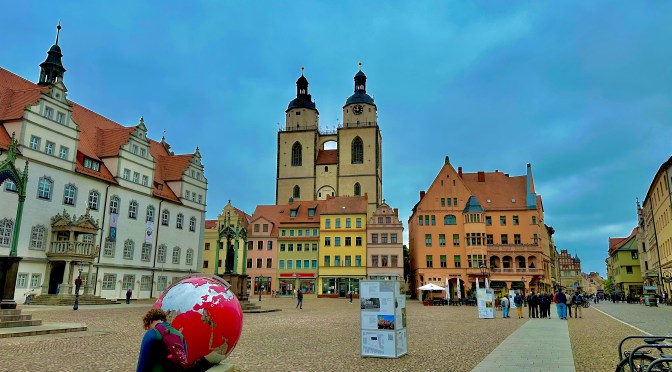
Photo: The town square and city hall in Wittenberg from where you can see the spires of St. Mary’s Church. Two Kingdoms side by side.

Returning to the Small Catechism

In my first call to ministry, I served a small farming congregation outside Edmonton. It was some of the most fertile farmland in Alberta, fed by the North Saskatchewan River. Since the mid-1800s, German immigrants had settled there having moved from the western parts of Russia. Serving that community was almost like stepping back in time, many members remembered when electric lights came to their farms. They recalled riding to church in horse, buggy, or horse and sleigh. 

The pastors of that community often served in a multiplicity of roles. They were also the local teacher, sometimes doctors, legal experts, and even postmasters! Confirmation was usually all day Saturday and included German language education, along with filling in the gaps that the local one-room grade school missed.

When I began serving, it was expected that I would attend the monthly Evangelical Lutheran Women’s (ELW) Bible Study. As we studied various things, I quickly discovered that many of the women could still recall much of the Small Catechism by heart, which they memorized in Confirmation classes. At the time, it felt like a curious artifact of history. 

Over the years in the ministry, I have continued to encounter Lutherans who could still recall the Small Catechism by heart (my mother is one of them!). I have come to see this less curious artifact of history and more blessing born in some brief teenage suffering in Confirmation class. 

The more and more I study Luther, and his theology, the more I am becoming convinced that despite those Lutherans of a certain vintage who can remember their catechism by heart, we, as clergy and church leaders, have mostly done a poor job of catechizing the people we serve. 

Last fall, as I prepared to teach the Lord’s Prayer to our confirmation class, I couldn’t help but wonder at how Luther’s explanation of the Lord’s Prayer is still so relevant today. 

‘People should know this!” was the constant refrain in my head.  As I have done Adult Study in the past and in the various other venues I have been privileged to teach, I have witnessed a hunger to know more and to go deeper. Even among confirmands — who might be the age where being interested in all this faith stuff is the most difficult — there has been an interest in learning the faith.

Before Christmas, I decided that teaching the catechism was something that I would do more. Starting on Sundays after worship, I will be inviting anyone who wants to join me, to grab a coffee following worship and have a brief discussion on one part of the Small Catechism. One of the commandments, one of the seven petitions of the Lord’s Prayer, or one line of one of the articles of the creed. The conversations won’t be long, maybe ten or twenty minutes, depending on what depths we can mine together. I hope to do this most Sundays. 

For several weeks, I was very proud of myself for coming up with this “Coffee and Catechism” idea. Until last week, through study and research, I discovered that my idea was not original at all. During the Reformation, the reformers would regularly preach on the catechism during the week, expecting that the children of Wittenberg would attend – along with the parents that brought them! Catechetical teaching was an important means of teaching the faith to people. Even then, it was not an original Reformation idea either. In the first three hundred years of the Church, when most converts were adults, as converts prepared for baptism through the season of Lent, the local Bishop would come and unveil the mysteries of God by teaching the 10 Commandments, the Creed and the Lord’s Prayer. 

So I might not be so original or brilliant, but I hope I am in good company. Most importantly, however, learning the faith is not something we do once in a couple of years when we are 13 years old, but something we continually come back to and learn again. 

The Beginning of Faith – Pastor Thoughts

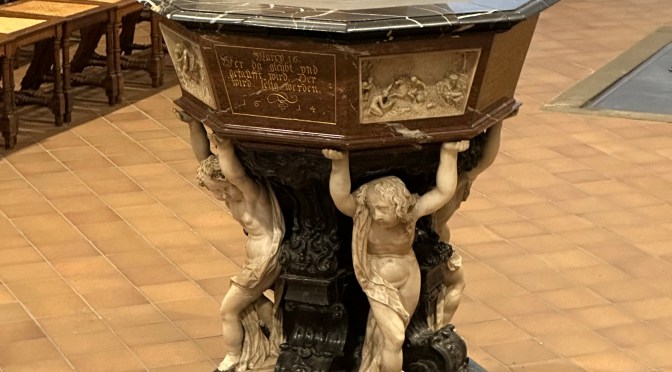
If you hear enough Lutheran sermons, you *should* have some sense that Baptism is a cornerstone part of our understanding of faith. (I will have to talk with my pastor colleagues if they haven’t made clear that Baptism is pretty important). Martin Luther pushed for a renewal of the Christian understanding of Baptism as centrally important to how we understand our identity as people who belong to God and as members of the Body of Christ. 

This week we hear the story of the Baptism of Jesus, which is important to come back to each year. As we are implored regularly in the liturgy, remembering our Baptism is an important part of our worship. The irony is that most of us don’t remember our own Baptism. So what does remembering our Baptism look like? Well, it is something we do as we hear about and witness the Baptisms of others. 

In the story of Jesus going down into the waters of the Jordan to be baptized by John, God proclaims that Jesus is God’s Beloved Son. This proclamation is not just for that moment but the proclamation that God makes to all who are baptized. It was the proclamation made over Sutton who was baptized last Sunday at our church. And it is the proclamation made to each person we bring to the waters and who is washed in the name of the Father, Son and Holy Spirit. 

But Baptism is still more than just a welcome for new babies and an entrance into the Church of Christ. The story of Jesus’ Baptism does not come to us in a vacuum. It comes to us in this season after Epiphany as we move toward Lent and Holy Week. The one who is baptized by John in the Jordan, whom God is well pleased with, will become the one who is crucified on Good Friday and who  rises again on Easter Sunday. 

St. Paul reminds us in Romans 6, therefore we were buried with him by baptism into death, so that, just as Christ was raised from the dead by the glory of the Father, so we also might walk in newness of life.”

In Baptism, God claims us as God’s own children. God names us beloved AND most importantly, God identifies us with the death and resurrection of Christ. God ties us to the in-breaking of God into the world with mercy and reconciliation. 

This essential part of Baptism is the beginning point of faith, that we die to sin and death in the baptismal waters with Christ and we are raised to new life by the resurrection of Christ. So when we gather together to witness a Baptism in our community, we are reminded that, just as this new Christian is now identified with Christ’s death and resurrection, so too are we, by virtue of the same Baptism with which we were baptized. 

As we hear this story of Christ’s Baptism this week, remember that it is the story of our Baptism, too.