
This week (for Sunday October 6th), the gospel of Mark covers an uncomfortable passage about divorce, where Jesus gives no reason that makes divorce palatable. The passage certainly feels like divine judgment hurled on something pretty common in our world (if you want to know why Jesus’ comments on divorce meant something very different than we may think, see this sermon from 2021). Whatever Jesus might actually be saying about divorce, the bigger question might be about the place of faith and religion in our world. There is the general question about the secularity of our North American culture but also the place and input that our faith has in our lives.
It is a question that I have been circling for the past month or so. Topics that have to do with faith in society and the church in the world include colonialism, Christian identity, how we talk among ourselves and others about the Church and so on. The question at the heart of my doctoral research is grounded in how we understand the role of Christian ministry in our lives.
On the surface, my research is asking about how people understand the work of clergy and the expectations out there that are placed on clergy. Deeper down, this is about exploring the place of Christian ministry in the world, as the work of clergy is done, along with, and equipping lay folks to be the hands and feet of the Church in the world. This, in turn, means digging into how contemporary Christians understand ministry and our collective work of ministry as the Church.
Perhaps more simply put, asking people what they think the job of a pastor is has to do with how we understand all of our roles in the work of ministry.
Answering this question is interconnected with another question facing many churches, including Sherwood Park, these days: What is our place and purpose in the world around us?
Like my research question, discerning our place and purpose in the world is a multifaceted question. There are lots of ways to begin answering it and lots of pieces that impact how we answer. What are we called to do and be as a community of faith in this time and place? Do we have the resources we need to carry out this ministry? Are there possible ministry partners around us with whom we can do more together than alone? What would happen if we didn’t carry out this ministry here? What would be lost? How can we change to faithfully entrust the legacy of our ministry to the next generation and into the future?
These questions take time to sort out. To answer them well as congregations requires us to put on the hats of researchers exploring all avenues of wondering, not knowing what answers might be out there. It isn’t easy to ask these questions because we aren’t used to the circumstances that we are in. Even if the Church has taken a few decades to slide into this situation, it feels new and uncertain and nothing like the version of being church that we know. All the things that we are talking about these days are not the things that pastors and church folks talked about in the past… at least that is not what I remember.
But on the longer time scale of the history of Christianity, questions about our place and purpose in the world are not new. The Apostle Paul addresses these questions frequently in his letters. The early Church had to deal with similar questions as it navigated living in the Roman Empire. The Reformers had to reinterpret the Church’s place in the world during the Reformation. Today, we are being called into another moment to ask this question – What is our place and purpose in the world?
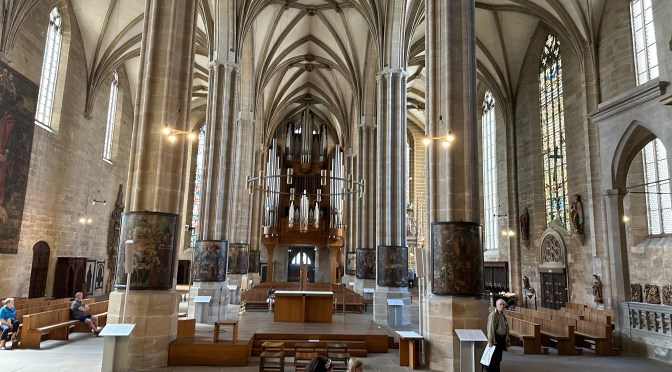
Photo: The modern chancel set into St. Mary Cathedral in Erfurt, Germany founded in 724 CE.
 The Millennial Pastor